Thursday, December 16, 2010

Loose Leash Walking (or how to not drive your human nuts)

One of my regular readers asked a question about walking on a leash. Her dog Claire, and aspiring therapy dog, is finding it difficult to become a registered therapy dog with the Delta Society because she tends to pull on her leash while walking. Claire's human partner was wondering if there were any tips she might use that could help out Claire with this portion of the exam. I'm so glad you asked!

First off, there seems to be an expectation that therapy dogs are perfect at all times under all circumstances. As the popular perception goes, we never jump up on someone, we never bark, we never pull our leash, etc. When is the last time you met a perfect human that was (for example) never crabby, never prone to overeating, and never snapped at another driver while waiting in traffic? That's what I thought! We all have off days, bad moments, or times when we behave in ways we wish we hadn't. We ought to have similar expectations for therapy dogs.

Take the experience my human and I had with the therapy dog exam. The human we very concerned about the neutral dog part of the test. I'm supposed to walk with the human up to another human with a dog. The humans talk for a few moments and then continue walking away from each other. I'm not supposed to be reactive toward the neutral dog.

The human was in a minor tizzy about this portion of the exam. I'm a super friendly pup and have this special way of whining and wiggling when I see another friendly dog. I'm not afraid of the dogs: I want to play with them. The human was convinced I would fail because I am seemingly incapable of walking past the neutral dog without displaying my extensive desire to play. What did I do at the test? I bet your first thought is that I was perfectly well behaved. You probably are thinking I was an exemplar of ideal behavior. Wrong! I did what I always do: I pulled on the lead a little, went up on my back feet trying to give a friendly hello to the human walking past my human, and generally was my normal happy playful self.

I didn't fail. Why? The human anticipated by response. He knew I was likely to do this so he was prepared to tighten my lead. He prevented me from going up on to the human (and thus also prevented me from having a close interaction with the neutral dog). When I went up on my toes to greet the woman he asked me to sit (which I did) and then we went on our way. Well it wasn't ideal, and I didn't pass that section with a perfect score, it was good enough. I'm a real world dog, my human is a real world human, and we know how to interact and be safe in real world situations.

On my therapy dog exam there was some space for there to be a tighter lead (rather than a loose lead). As you all know, I am part Basset Hound. Among other things, this means that my nose is the most important organ in my body. My body is lead through the world by my nose. I walk around (for the most part) with my nose to the ground. I'm not all that interested in listening to other people when I catch a scent of something I like. That is my nature. It isn't my nature to be prance next to my human. He's always going to have to be aware of me when walking in crowded environments: if I catch a smell I am going to follow it. He'll have to be ready to tighten up my lead a bit and give me a little extra guidance. No big deal, and no reason for me to fail a therapy dog examination (after all, during the part when I was supposed to be walking on a loose lead I had my nose stuck to the ground trying to follow the scent of something good).

So my first suggestion for loose lead walking is to be easy and alter your expectations. Be aware of your dog, know what she is doing, know what is in your environment, and be proactive. It isn't about being perfect: it's about being safe and in control.

My second suggestion is to balance your walking times with opportunities for your dog to explore on her own with time when your dog is expected to follow your lead. Teach your dog a word to differentiate between the two different experiences. When I am expected to walk close to my human and not explore he says "follow me." When I am allowed to direct my own walk he says "explore."

How do you teach the difference between "follow me" and "explore?" We started with "watch me." When I was a young puppy I started to learn watch me. Whenever I made eye contact with my human he said "watch me" and gave me some sort of reward (excited happy petting, a piece of kibble, a click on the clicker, etc.). When we were learning to walk on a lead we practiced that same skill. If I'm watching my human, I can't be sniffing. If I'm watching my human, I can't be barking at other dogs. As an added bonus, since I am also part herding dog I like watching things and keeping them together. Sometimes it is debatable if the human is leading me or if I'm herding him in any particular direction.

Anyway, over time "watch me" expanded into "follow me" and "stay close." When I strayed way and pulled on the leash I would hear "watch me." I knew this means if I looked at my human I'd get some sort of reward (most of the time, but not always). In order to receive my reward I'd have to (a) watch the human and (b) be close enough to the human so I could reach the reward. Without any effort at all I would start doing "follow me" which means walk very close to the humans leg, look up at him, and lick my lips in hope of getting a yummy reward. For the most part my reward now is that I touch my human's hand with my nose, wag my tail, and continue a happy walk.

Sounds easy? Right? It both is very easy and it isn't very easy. Training like this takes a lot of time, patience, and practice. Those who want their dog to instantly "heel" won't be satisfied with this technique because it isn't an instant technique (in my opinion, there are not instant techniques). I've gotten good at these skills but I'm still not "perfect." Sometimes I ignore my human. Sometimes I pull. When the human collected his patience, we start back to the beginning with a "watch me" and we continue. This is a life time practice.

I've seen dog trainers do all sorts of things. Some use a "choke" collar assuming that a dog will stop pulling to escape from the unpleasant sensation of their neck getting constricted. Usually this just seems to result in dogs that pull and wait for their humans to escape from the unpleasant sensation of being pulled. It's also dangerous (numerous dogs have suffered numerous injuries from these sorts of collars). Lastly, training like this doesn't start with the basis of giving your dog something to do (watch me, follow me, etc.). It starts with the basis of telling your dog what not to do. Humans (children and adults) as well as dogs do best when they are shown what they are supposed to be doing (given an antecedent) and then monitored to make sure they are performing that request. It's unrealistic to think that anyone will do what you want them to do if you give them a consequence for doing it prior to teaching/showing them what you want them to do.

I've also seen trainers do things like step in front of a pulling dog with one leg to block their path. My human is someone clumsy so this generally involved in him tripping and falling or stepping on me. In the end I don't think this is very effective because again, it's not starting with the expectation of what you want the dog to be doing. This isn't showing the dog how to follow, it's showing the dog that you want him to avoid getting stepped on.

I've seen trainers also walk in the opposite direction that the dog is pulling in. It makes for short frustrating walks. The idea here is that (a) the dog wants to walk in one direction and have a good time) and (b) the dog doesn't get to do that unless she complies with what you are asking. This can be effective as long as you first teach the dog what you want her to do (watch me, follow me, etc.). The dog does what is asked (watch me, follow me) and they get what they want (a reward, continued walking, praise, etc.). They don't do that and they don't get to continue walking (a good time to practice sit/say or a time to walk in the other direction).

There is one down side to teaching a dog "watch me." I find that I get into watching my human so much I will occasionally walk into things because I'm focused on him rather than where I am walking.

This help Lauren? Try it out and let us know what you think.

Saturday, November 27, 2010

On Therapy Dog Examinations, Fear, and Systematic Desensitization

Last Sunday was the big day--it was finally time to take my examination to become a therapy dog. Once my paperwork is processed, I'll officially be a registered pet partner with the Delta Society. The human was excessively worried about the test. There were a few key things that he thought I'd have difficulty with--things that might actually cause me to fail.

His biggest concern was that as a rule, I hate being brushed. The brush comes out and I immediately start mouthing the brush. Part of the exam is being brushed by the examiner and in order to pass said exam I can't be eating the brush. He practiced and practiced brushing me. The general principle was that every time the brush came out he'd bring out food. As he brushed my fur there was a steady stream of little rewards entering into my drooling mouth. He thought for sure this would work. That is, he though for sure it would work until one day he left the brush on a table and I snuck off with it and chewed it.

What did I do during the exam? The brush came out and I rolled over to get my belly brushed.

The next worry of the human was the neutral dog. On a lead, I walk on the outside of the human as he passes another human with a dog on a lead. The humans stop for a few moments, shake hands, and exchange pleasantries. I'm not supposed to lunge, bark, snarl, or otherwise be inappropriate toward the human or the other dog. I'm not an aggressive dog by nature: that wasn't the human's concern. Rather, I'm a playful dog. Each and every dog that I pass is considered a potential best friend. I like to way my tail, do a play bow, and otherwise try to entice the other dog to say hello to me. This is somewhat problematic for the test.

What did I do? Exactly what the human anticipated. He stopped and shook hands with the other human. I went up on my rear feet hoping that I could shake hands with the human too. I passed this portion--while I didn't pass it with flying colors it was okay because the human was in control of me. He made sure I didn't get onto the other human.

The problem I faced--and what almost caused me to fail my exam--was totally unexpected. During the exam I was examined by the examiner. He was supposed to touch my paws, look in my ears, look in my mouth. He then went on to pet me in an exuberant and clumsy way and give me a restraining hug.

These are all things that happen to me on a regular basis. Those of you who meet me in the office know that I love this. We have one particular patient who comes running into the office, sits on the floor, and proceeds to roll me over, pat me vigorousness, squeeze me, and otherwise show me exuberant affection.

What did I do during this portion of the exam? The examiner was wearing a puffy winter vest. He took it off prior to getting down on the floor. I took that as my cue to hide behind my human to do anything I could do to avoid the situation. I displayed just about every sign I could that I was scared and exhibited every one of Turrid Rugaas' calming signals. We repeated that portion of the exam with a female examiner and I did marginally better.

The human first thought that it was the removal of the puffy winter vest. The human doesn't wear puffy winter vests and I've never seen one. In light of me become scared when I saw it being removed, he assumed at first that it was the stimulus that put me into a fear response. I wish I could speak: if I could I would have told the human that he had it all wrong. Thankfully he figured it out on the way home.

To understand why I got so scared the human needed to think about four other pieces of information.
  1. The examiner was male
  2. The examiner had a scruffy beard
  3. Several months ago, for no apparent reason, I became fearful of a patient who has a scruffy beard. Previously I would sit in his arms and nuzzle the side of his neck.
  4. Several months ago I became afraid of a homeless man with a scruffy beard that I used to run to greet.
So how does this all fit together? Why did I get scared? The human has been curious about the last two pieces of information for some time now. My behavior change was sudden, unexpected, and very localized. Other than those two situations I am outgoing, friendly, and confident.

Driving home from the examination I could see the light bulb appear over the human's head as he thought of one more piece of information. I was eager and excited to go to the vet as a puppy. I thought it was big fun to be examined, played with, and given attention. I would actually scamper into the vets office with my tail wagging! In a large part, this happened because my human went to the vet with me multiple times as a puppy and just walked in the door. No exams, no shots. He asked everyone to pet me and I learned that this was a good place to be.

As regular readers know, I had some bladder issues in the late summer and fall. No one could figure out what was going on and I needed all sorts of tests. Naturally, I started to become afraid of the vet--and guess what--the vets who did those procedures were men--some of which had scruffy beards.

The worst experience was when they tried to take a sterile urine sample from me. The vet and vet techs took me into the procedure room, strapped me down on my back, and inserted a tube into my bladder. The first time they did this I had just peed so there was nothing for them to take. A week later they did it again and I hadn't peed. I learned here that the vet was a scary place. Now rather than walking into the vet's office I started pulling away from the human at the door, displayed many signs of fear, and generally had an unpleasant time at the vet's office.

For a variety of reasons, the human fired that vet. He felt like he wasn't being treated like an equal partner in my health care and questioned the vet's knowledge. We tried a new vet. This office wanted to do more procedures--this time an x-ray and ultrasound. They needed the human to leave me at the vet's office. He asked if I could be given a tranquilizer--which they refused. Begrudgingly, he left me there as I was trembling. There again I was strapped down to a board and given procedures without any sort of tranquilizer. The human again questioned if this was a good idea and fired that vet because he felt like he wasn't being treated like an equal partner in my health care and questioned the vet's knowledge.

The third time was charm. The new vet had a holistic remedy for my issues and they have completely cleared up. I'm still afraid of the vet but have learned that I can walk into the office without trembling (we are back to random visits for playtime with the office staff).

Anyway, this is all to say that I was not afraid of the puffy winter vest. I was afraid of a man with a scruffy beard attempting to examine me. I learned that when men with scruffy beards examine me they usually restrain me and do very uncomfortable things. I've learned that it's best to avoid these sorts of men because if they restrain me, there isn't anything I can do but to wait it out.

The human feels he has enough data suggesting that I have a trauma response going on. Since I can't talk, I can't tell him if he's right. In the absence of other compelling data, he's going to move forward with a treatment plan that would be appropriate for a traumatized dog.

What's the treatment plan? Systematic desensitization. What's that? It's a procedure that one can do to reduce a trauma response to stimuli. It goes something like this. First off, the human prepared a list of stimuli that are triggering a fear response. He arranged the list in order of least triggering to most triggering. He then is exposing me to these stimuli in order, and pairing them with a pleasurable stimulus.

For example, the patient who I'm now afraid off gets to give me a piece of food every time he comes into the office. The human makes sure that it is successful every time. He keeps me on a lead so I'm in his control, close to him, and feeling safe. The other human will approach me in a positive way and offer me the food. If I take it, great. If I don't, that's great too. My human will praise me and continue to support me in feeling safe and secure. We take things at my own speed and I eventually learn that men with scruffy beards in the office are okay.

The human also makes sure that he encourages my curiosity when we are walking in Cambridge and we come across all sorts of different people. He lets me meet people at my own pace. If I show any signs of fear we slow down and he gives the other person a small bit of food to offer me. Every time this happens, I'm learning two things (a) it's okay to go slow and (b) when my human is interacting with someone they are usually friendly people who offer me food.

That's how systematic desensitization works. It's a slow process that builds successful experiences upon other successful experiences. It's been tested an replicated in scientific literature over and over again. It's effective, safe, and a powerful agent of change.

An alternative is flooding that has been popularized on television by dog trainers such as Caesar Millian. When flooding is used in dogs, humans, and other creatures the individual is held within the context of a fearful stimuli and not released, no matter what the creature does, until the creature gives up. In this case if I was strapped down onto a table by a human and wasn't released from the situation, no matter what I did, until I gave up--that would be flooding.

Keep in mind that most people confusing negative reinforcement with flooding. In negative reinforcement, a creature can exhibit a certain behavior that will cause the stimulus to stop. For example if I was strapped to the table and released only when I was calm, that would be negative reinforcement. If I remained tied to a board after I gave up that would flooding. Remember that with flooding, there is nothing a creature can do to escape a stimulus other than to give up and wait.

In some cases, flooding works. The human does not use it for treating humans, dogs, or any creature. Flooding doesn't provide a creature with useful coping skills to approach novel situations with confidence. It teaches a creature to give up and not respond.

With systematic desensitization a creature is provided with tools (humans can be taught coping skills to reduce levels of anxiety, dogs and other creatures can have their natural coping skills reinforced and enhanced) to meet a fearful situation with success.

Try it out--and be sure to ask your dog trainer or friendly psychologist for help. Any behavioral intervention needs a qualified expert to help you design a program that works.

Thursday, November 18, 2010

Greatest Discover, Ever. Really.

So I've been meaning to tell you all about my most recent discover. It's the greatest discover ever. Really. I don't know why I ever noticed these things. To what am I referring? Windows. That's right. Windows. Did you all know about them? A couple nights ago after work we were walking back to the car. I've probably sniffed right past this spot a good 100 or so times in my life but I never actually bothered to look up. My nose is usually down to the ground savoring all the ground-level aromas.

So here it is, nine at night, and I finally lift my head up and discover this thing called a window. It just wasn't any window. It was the window on the left of the picture that belongs to the restaurant that I'm told is named Arrow Street Crepes. It was also a very special window as inside of it I discovered this wonderful woman who was munching a crepe. This was clearly a moment of two lovers meeting for the first time. I looked up, noticed her, and tilted me head. She looked down at me and smiled. I started wagging my tail. First I just fluttered the tip of my tail. I wasn't sure what this whole human behind the window thing was. As soon as she started smiling at me I went all out wagging my tail with all all the gusto I could muster. The woman smiled even more, so I wagged even more.

We stood there for a few moments--human and dog look at each other and showing each other how happy we were to see each other. I've got no real way to know what she was thinking: she never came out behind the glass. The only thing I do know is that when I took the time out of my sniffing to look up she happened to take the same moment to look down from what she was eating and we both made a connection. It couldn't me more simple than that--two creatures reaching out and making a connection that brings a moment of happiness into the world.

When's the last time you looked up?

Saturday, November 13, 2010

Weir Hill Reservation

Winter is almost here. That means a couple of things. First off, it's been cold at night so all the ticks are dead. Second, there isn't a lot of sunshine left to enjoy in New England so it's best to get outside and soak it all up. As it turns out, only one of these statements are true. The human found a tick on his hiking companion. I made out much better: I had a bath to remove all the forest dirt but there were not ticks to be found on my body.

Below are a few images from my adventures today.


Saturday, November 6, 2010

When hats, dogs, and humans meet

As you all previously saw, the human was rather insistent on me wearing a Halloween costume this year. Like most other humans, he apparently finds it amusing to see pets in costumes. We went through this last year with the pink wig. I told him time and time again that I didn't like the wig. I tried to hide the wig. I tried to eat the wig. I tried to shake and kill the wig. Finally I resorted to the only other thing left: I gently tried to eat the human's hand so he knew I didn't like the wig. Did he listen? NoooOoooOo! Of course he didn't. Well I warned him. Didn't I?


Please direct your attention to the following three images. In the first the human and I are having a tender moment resting in the evening sunshine. Doesn't it look idyllic? The warm light of the autumn sun makes us glow. I'm gazing at him with my undivided, unconditional love. You'd think he'd just enjoy it, right? Of course  not.


Out of the blue the human surprises me with a hat. Not just any hat. It's that stupid barmaid hat that I told him that I utterly despised. To make matters worse, he had the nerve to stick his tongue out at me. He knows that drives me nuts. When will he ever learn?
Here in this last picture I'm again finding myself having to give the human a "talking to." I'm threatening to put a leash on him if he doesn't learn to behave. What do you all think? How can I get through to him so he stops trying to make me wear hats?

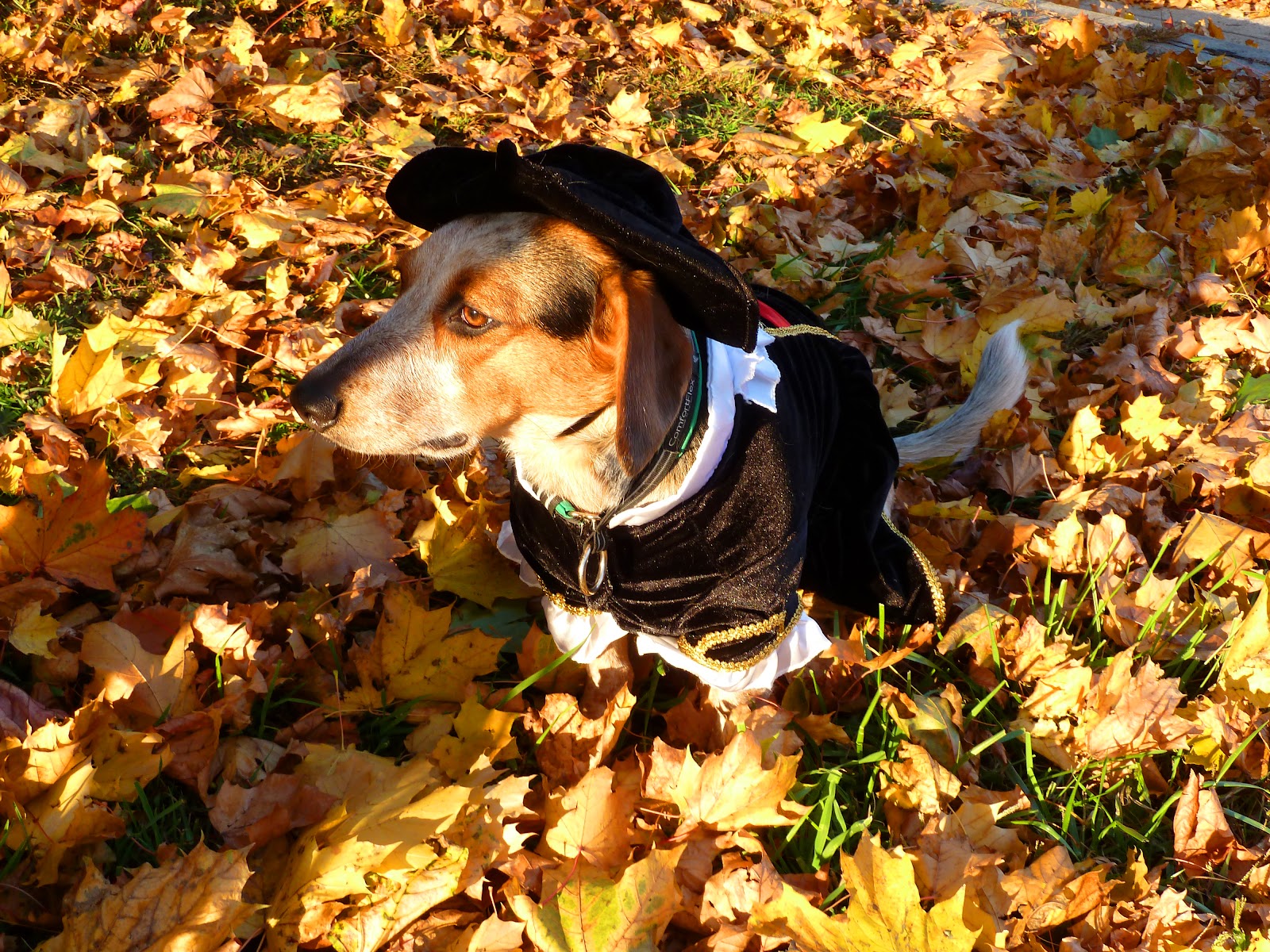
Halloween Costume (finally!)

So after multiple requests, I'm begrudgingly posting some pictures of me in my Halloween costume. I work so hard at having my tough-girl image (playing with all the big dogs, running with sticks, bossing around dogs four times my size, etc.). These pictures show a different side of me that is well, a little embarrassing!